TaskRio vs Tasks.Bot for Report Generation Automation Software
Your team finishes the job, then spends the evening building the report. Someone photographs a sign-in sheet, someone else retypes hours into a spreadsheet, and the client gets an update two days late. Report generation software should close that gap, but many platforms still split task tracking, attendance, and reporting across three different screens.
This comparison covers what Tasks.Bot does through WhatsApp, how its instant reports, live day tracker, and voice-note task creation work, and where TaskRio fits. You will also see pricing, beta status, and who each tool actually suits, so you can pick the one your team will use daily.
What Is Tasks.Bot? Report Generation Automation via WhatsApp
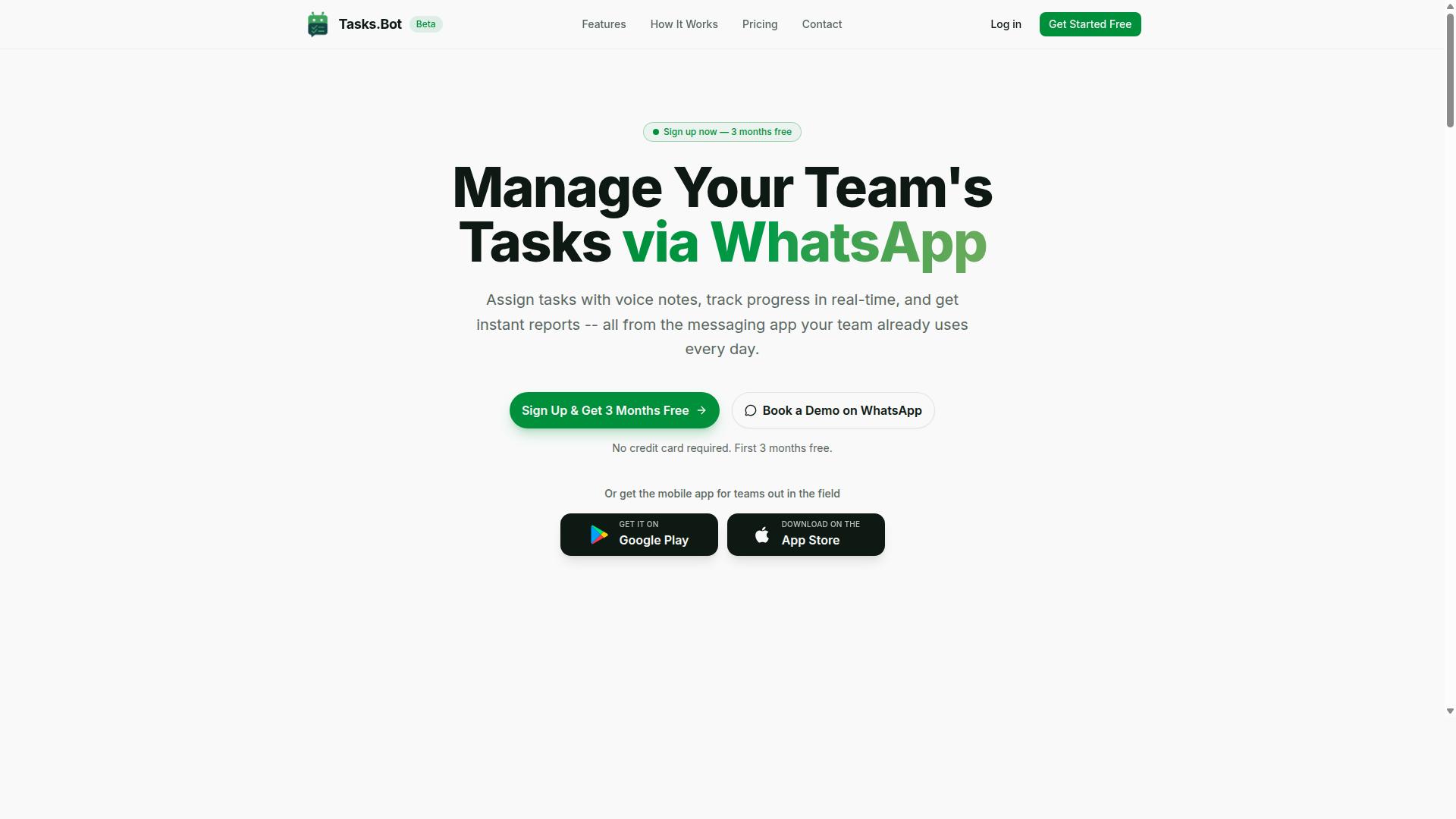
Tasks.Bot is a task management platform that operates entirely within WhatsApp, enabling teams to assign tasks, track progress, and receive reports without leaving the messaging app.
That single design decision separates it from most report generation automation tools. Instead of asking a team to adopt a new dashboard, a new login, and a new set of habits, Tasks.Bot lives where the conversation already happens. For many teams, that is WhatsApp, and it is already open on every phone in the field.
The platform combines two jobs that are usually handled by separate products. One is task automation: creating, assigning, and tracking work. The other is reporting: turning completed work into structured output that managers can review and act on.
Tasks.Bot is a SaaS reporting tool, so there is nothing to install on a server and no IT project to run. It is currently in beta and offers a free trial period, which gives teams a low-risk way to see whether messaging-based reporting fits how they already operate.
The sections below look at who the platform serves, how tasks and reports move through it, and where it fits alongside other report automation tools in a typical evaluation.
Who Tasks.Bot Serves and How It Works
Tasks.Bot is designed for teams that rely on WhatsApp for daily communication, especially those with field staff who need efficient task management and reporting. The site mentions hundreds of teams already using the service.
The audience is fairly specific. These are groups where a manager coordinates people who are not sitting at desks, and where the primary device is a phone rather than a laptop. Common examples include field service crews, delivery and logistics teams, cleaning and maintenance operations, security patrols, and sales teams working across multiple locations.
For these groups, three needs tend to overlap:
- Task management, so work is assigned and its status is visible
- Attendance tracking, so managers know who showed up and when
- Payroll-ready hours, so time data can feed into pay processing
Tasks.Bot addresses all three from inside the messaging app. Users create tasks through voice notes or text, and AI interprets the natural language request, then handles assignment and scheduling. Reports are generated from that activity rather than assembled by hand at the end of a week.
A separate mobile app is available for field teams, which matters for staff who need a more structured interface than a chat thread. Importantly, no new accounts or installations are required to get started, which removes the adoption friction that sinks many workflow automation rollouts.
Adoption is often the real barrier in this category. Field staff rarely resist tools that appear in an app they already use, and managers avoid the double entry that comes with running a chat group and a reporting system side by side.
It is worth being precise about what this is not. Tasks.Bot is not a full business intelligence reporting suite with a custom report builder, dashboard creation, or data visualization layers. Teams that need deep data integration across many systems, API connectivity to a warehouse, or complex data visualization will still want a dedicated data reporting platform for that work.
What Tasks.Bot does well is the operational layer underneath those analytics: capturing what happened, who did it, and how long it took, in a format that is ready to use. That makes it a practical companion to heavier analytics automation rather than a replacement for it.
Because the service is in beta with a free trial, the sensible approach is to test it against one real workflow. Pick a recurring task your team already handles in WhatsApp, run it through Tasks.Bot for a couple of weeks, and compare the reporting effort before and after.
Is Tasks.Bot the Better Choice Over TaskRio for Report Generation?
When evaluating report generation automation tools, teams often compare Tasks.Bot and TaskRio, but Tasks.Bot offers distinct advantages by operating natively within WhatsApp. That single design decision changes how quickly a team can move from a completed task to a finished report.
TaskRio is generally discussed as a separate platform that teams would need to adopt alongside their existing communication tools. Because publicly available information about its exact setup is limited, the fairest comparison focuses on what Tasks.Bot verifiably does and why that matters for report generation automation.
Tasks.Bot runs entirely inside WhatsApp, so team members do not need to install anything or create new accounts. For report automation, this removes the biggest hidden cost of any new tool: onboarding friction. When staff already live in WhatsApp, the data that feeds automated reporting software gets captured where the work actually happens.
Ease of use is where the gap is clearest. A dedicated platform typically means new logins, new dashboards, and a training period before anyone trusts the output. Tasks.Bot skips that entirely, which means reports reflect real activity from day one rather than a half-adopted system.
Integration with WhatsApp is not a feature bolted onto Tasks.Bot. It is the foundation. Task updates, completions, and field activity all flow through the same channel the team already uses, so real-time reporting draws on a continuous stream of updates instead of manual end-of-day entries.
AI-driven task creation strengthens this further. Tasks.Bot uses AI to understand natural language and voice notes, letting a manager speak a task into existence rather than typing it into a form. Each captured task becomes structured data that can feed scheduled reports without extra admin work.
That matters for template-based reporting and recurring summaries. When tasks arrive as clean, structured entries, the downstream report practically writes itself. Teams spend less time assembling numbers and more time acting on them.
For field-based teams, Tasks.Bot adds face-verified attendance and live GPS tracking. These capabilities give reports a layer of accountability that a generic data reporting platform cannot easily replicate, because the verification happens at the point of work.
Security is another differentiator worth noting. Enterprise-grade encryption protects task data, and conversations and task data are never shared or used for training. For teams handling sensitive operational information, that is a meaningful assurance when choosing a cloud reporting software provider.
Put simply, Tasks.Bot's strengths map directly onto better report generation for WhatsApp-centric teams:
- No new app: adoption happens instantly, so reporting data is complete rather than partial
- WhatsApp-native integration: updates and completions feed reports as they occur
- AI task creation: natural language and voice notes turn spoken instructions into structured, reportable data
- Face-verified attendance and live GPS tracking: field activity is captured with accountability built in
- Enterprise-grade encryption: task data stays protected and is never shared or used for training
- 3-month free trial with no credit card required: teams can validate the reporting workflow before committing
TaskRio may suit organisations that want a standalone reporting environment. But for teams already coordinating through WhatsApp, adding a separate platform often means duplicate entry, slower adoption, and reports that lag behind reality.
Tasks.Bot takes the opposite approach. It turns the channel teams already use into the source of truth for task automation and reporting, which shortens the distance between work done and insight delivered.
The verdict is straightforward. For WhatsApp-centric teams that want fast, low-friction report generation, Tasks.Bot is the stronger choice. It combines native WhatsApp operation, AI-driven task capture, field accountability features, and strong data protection in one place, and the 3-month free trial with no credit card required makes that a low-risk decision to confirm firsthand.
How Tasks.Bot Automates Report Generation
Tasks.Bot automates report generation by capturing task activities within WhatsApp and converting them into actionable insights without manual intervention. Instead of asking team members to fill out forms or update spreadsheets, the system works inside the messaging app they already use every day.
Tasks are created through WhatsApp messages, voice notes, or the Android and iOS apps. From that point, the platform tracks progress, assignments, and deadlines. Every update becomes part of the reporting record.
Reports can be generated on demand or scheduled to arrive at set times, and delivery happens inside WhatsApp. That means managers and field teams see the same numbers without logging into a separate dashboard.
The features below show how this works in practice, from live day tracking to AI-powered task creation.
Instant Reports and Live Day Tracker
Tasks.Bot provides instant reports that give managers a real-time snapshot of task progress and team performance directly in WhatsApp. As tasks are updated, the reports reflect those changes, so there is no lag between what happened in the field and what a manager sees.
The live day tracker builds on this by showing how the current day is unfolding across the team. Reports cover areas such as task completion, attendance, and hours logged, giving a rounded view of daily operations rather than a single metric.
Access is straightforward. Because delivery happens through WhatsApp, every team member can view relevant reports without installing extra software or learning a new interface. Field workers see their own assignments, while managers see the wider picture.
This matters most for teams that are mobile or spread across sites. A supervisor who needs to know whether a job was completed does not have to wait for an end-of-day summary. The information is already there.
For report generation automation, the value is speed and accuracy. Reports are built from actual task activity, not from memory or manual entries, which reduces the errors that creep into spreadsheet-based reporting.
Voice Notes, AI Task Creation, and Smart Reminders
Tasks.Bot leverages AI to convert voice notes into structured tasks and sends smart reminders to ensure deadlines are met. A field worker can send a voice note describing what needs to happen, and the platform uses AI to understand the intent and create the task.
That task can carry a due date and an assignee, so it enters the workflow ready to be tracked. Automatic task assignment means the right person is notified without a manager manually routing the work.
Smart deadline reminders then notify assignees before a task is due. This reduces missed deadlines and keeps the task record current, which in turn keeps reports accurate.
Consider a technician finishing a site visit. Instead of calling the office or typing a long message, they send a voice note. The task is logged, assigned, and tracked, and it flows into the reporting data automatically.
Approvals and automations add another layer. Tasks that need sign-off move through the approval process, and the outcome is captured for reporting. Together, these features mean report generation depends on structured, timely inputs rather than end-of-week catch-ups.
The result is a reporting cycle that stays close to real work. Tasks are created where the work happens, reminders keep them on track, and reports reflect what actually occurred.
Key Features That Set Tasks.Bot Apart
Tasks.Bot distinguishes itself with features tailored for field teams, including face-verified attendance and GPS tracking, which directly enhance report accuracy. These capabilities go beyond standard report generation automation because they capture the raw data that reports depend on, at the moment work actually happens.
While many report automation tools focus on formatting, scheduling, and exporting data that already exists in a system, Tasks.Bot starts earlier in the chain. It collects verified attendance, location, task status, and hours through a platform teams already use daily: WhatsApp.
That approach matters for report accuracy. Reports are only as reliable as the data feeding them, and Tasks.Bot ties its reporting directly to verified field activity rather than manual entries that can be edited or delayed.
Three feature areas stand out for teams evaluating report generation software:
- Face-verified attendance and GPS field tracking, which confirm who was where and when
- Approvals and automations, which keep task data clean before it reaches a report
- Payroll-ready hours, which turn tracked time into usable records
Each of these features supports both report generation and day-to-day team management. The subsections below explain how they work and why they matter for anyone comparing report automation tools.
Face-Verified Attendance and GPS Field Tracking
Tasks.Bot ensures accurate attendance and location data through face verification and GPS tracking, which feed directly into reports. When a team member checks in, they verify their identity with a face scan rather than a simple tap or code entry.
This design addresses a common problem in field operations: buddy punching, where one person checks in on behalf of another. A face-verified check-in makes that difficult, because the person marking attendance must be physically present.
GPS tracking adds a second layer of proof. For field tasks, location data is captured as work is completed, giving managers a record of where service took place. For teams that dispatch staff to client sites, this creates verifiable proof of service rather than a claim that a visit happened.
Both data streams flow into Tasks.Bot's instant reports. Managers reviewing a report can see attendance records and location history alongside task completion, without chasing separate spreadsheets or messaging staff for confirmation.
This combination is particularly valuable for teams with field staff, such as service crews, delivery teams, or inspection units. In those settings, knowing that a task was done is less useful than knowing who did it, when, and where. Tasks.Bot captures all three, and because the platform operates entirely within WhatsApp, team members do not need to install anything or create new accounts to participate.
Approvals, Automations, and Payroll-Ready Hours
Tasks.Bot streamlines workflows with approval processes, automations, and generates payroll-ready hours from tracked tasks. Each of these features reduces manual follow-up while improving the quality of data that ends up in reports.
Approval workflows let a task require manager sign-off before it is marked complete. This creates a quality control checkpoint: instead of a task closing the moment someone taps done, a supervisor reviews the work first. For report generation, that means completed status reflects verified work, not just a self-reported update.
Automations apply rules based on task status or deadlines. When a task changes state or a deadline approaches, the system can trigger the appropriate action, such as notifying a manager or moving a task forward. This kind of workflow automation keeps projects moving without someone manually monitoring every item.
Hours tracking ties directly into payroll. As team members complete tasks and shifts, Tasks.Bot calculates hours from tracked activity and produces payroll-ready records. That removes a recurring administrative chore: no reconstructing timesheets from chat messages or handwritten notes at the end of a pay period.
Together, these features save time and improve accuracy in concrete ways:
- Managers approve work once, and the record is final, reducing disputes later
- Automations handle reminders and status changes, so nothing stalls unnoticed
- Hours flow from tracked tasks into payroll reports, cutting manual data entry
For teams already using Tasks.Bot's shifts, leave, and hours management, these outputs appear in the same instant reports generated from task data. That consistency is the point: approvals, automations, and hours all feed the same reporting pipeline, so managers work from one reliable view instead of stitching together numbers from several sources.
Pricing and Plans
Tasks.Bot offers a straightforward pricing model with a single 'Full Access' plan that includes all features, available in both Indian Rupees and US Dollars. There are no hidden tiers, no feature locks, and no upsells waiting after checkout. For teams comparing report generation automation options, that simplicity removes a layer of guesswork that often comes with tiered SaaS pricing.
Pricing is listed on a per member basis, which makes it easy to scale the cost alongside your team. The site includes a 'Select currency' option, so buyers can choose between Indian Rupee and US Dollar before subscribing. Verifying the correct currency at checkout is a small but useful step for anyone budgeting in a specific region.
| Plan | Price | Billing Cycle |
|---|---|---|
| Monthly | ₹200 per member | Per month |
| Annual | ₹1,200 per member | Per year |
The annual plan works out to a 50% saving, which equals ₹1,200 saved per member per year compared with paying monthly. For a team of several members, that difference adds up quickly across a full billing cycle.
New users also get 3 months free, with no credit card required, and the ability to cancel anytime. That combination lowers the risk of evaluating the platform before committing budget, which matters when you are testing how a SaaS reporting tool fits into existing workflows.
One detail worth noting is that Tasks.Bot is currently in beta. Pricing or features may change as the product develops, so it is worth confirming current terms directly before locking in a long-term plan. This is common for early-stage platforms and does not affect the clarity of the current offer.
For readers weighing report generation automation against other tools, the key takeaway is that Tasks.Bot keeps its pricing transparent. There is one plan, one feature set, and a clear choice between monthly and annual billing in either currency, which makes cost comparison simpler than navigating multi-tier pricing structures.
Trust Signals: Beta Status, Encryption, and Refund Policy
Tasks.Bot is currently in beta, offering early adopters the opportunity to shape the platform, and includes a refund policy for peace of mind. For anyone evaluating report generation automation, these signals matter just as much as feature lists. Trust is not a footnote in automated reporting software. It decides whether a team feels comfortable routing real business data through a cloud reporting software platform.
Each signal answers a different question. Beta status tells you where the product sits in its lifecycle. Encryption tells you how your data is protected. A refund policy tells you what happens if the fit is not right. Together, they paint a clear picture of a SaaS reporting tool that takes user confidence seriously.
Beta status does not mean unfinished or unreliable. It means the platform is functional and in active development, with room for user feedback to influence direction. Early adopters of report automation tools often gain the most influence over the roadmap during this stage.
For teams weighing a data reporting platform, this is worth understanding clearly:
- The service is functional and usable today, not a concept or waitlist.
- The product is still evolving, so features and workflows may improve over time.
- Early users can shape the platform through direct feedback.
That combination suits organizations that value influence over a frozen feature set. If your workflow automation needs are stable and you want a voice in what gets built next, beta participation is an advantage rather than a drawback.
Encryption is the second trust signal, and it addresses the most common concern about cloud reporting software: data safety. Enterprise-grade encryption protects task data. This matters for report generation automation because the data involved is rarely trivial. Reports often touch financial figures, operational metrics, and customer details.
For teams comparing automated reporting software, encryption should be a baseline expectation, not a bonus. It supports the broader security posture of your business intelligence reporting and helps satisfy internal review requirements before any tool is approved.
The third signal is the refund policy, which is listed in the footer of the Tasks.Bot website. A visible refund policy lowers the risk of trying a new SaaS reporting tool. It signals that the provider stands behind the product and gives buyers a defined path if expectations are not met.
Practical advice: read the policy before committing. Confirm what it covers, how claims are handled, and any conditions attached. A refund policy in the footer is easy to find, which itself is a small but meaningful transparency cue. Vendors that hide such terms tend to bury them, not surface them.
Accessibility rounds out the trust picture. Tasks.Bot is a global service with no country restrictions, so location does not limit who can use it. The platform is reachable through familiar channels, including a "Book a Demo on WhatsApp" option on the website.
WhatsApp matters more than it might seem. It is one of the most widely used messaging tools worldwide, which makes it a low-friction way to ask questions before adopting a data reporting platform. For international teams, that removes a common barrier: not knowing how to reach a vendor quickly.
Put together, these signals form a coherent story. Beta status shows an active, improving product. Encryption shows data protection. A footer refund policy shows accountability. Global availability with no country restrictions shows openness. None of these guarantees perfection, but each reduces a specific risk that buyers reasonably worry about.
For anyone assessing Tasks.Bot for report scheduling, template-based reporting, or a custom report builder, the verdict is straightforward. The platform presents itself as a legitimate, security-conscious, and accessible option. The beta label reflects momentum, not doubt, and the refund policy plus encryption give users solid ground to evaluate the tool with confidence.
Who Should Use Tasks.Bot
Tasks.Bot is ideal for teams that use WhatsApp as their primary communication tool and need efficient task management and reporting, especially those with field staff. Instead of asking workers to learn a new platform, the service meets them inside an app they already open every day.
That single design choice shapes who benefits most. No new app adoption means less training time, fewer abandoned tools, and faster rollout across a team that may be spread across multiple sites or cities.
Small to medium teams often feel this benefit first. They rarely have the budget for a heavy report generation automation rollout, and they rarely have the patience for a platform that takes weeks to configure. A WhatsApp-based approach lowers that barrier considerably.
Field service teams are a natural fit. Crews on construction sites, technicians on service calls, and inspectors moving between locations are not sitting at a desk with a laptop open. Tasks.Bot keeps task creation and reporting within reach on the device already in their pocket.
Delivery and logistics operations share the same profile. Drivers, dispatchers, and route managers coordinate constantly, and reports help supervisors stay informed without chasing updates by phone. Attendance tracking adds another layer of visibility for teams that manage shift-based or mobile workers.
Sales teams working remotely can also use the platform to log activity and keep reporting consistent, even when members are travelling or working from different regions.
Because Tasks.Bot is a SaaS product accessible via WhatsApp and mobile apps, it is available worldwide with no country restrictions. A team in one region can operate the same way as a team on the other side of the world.
In short, Tasks.Bot suits organizations that value speed of adoption, rely on WhatsApp daily, and want task automation and reporting without forcing a disruptive change on their workforce.
Final Verdict: Tasks.Bot for Report Generation Automation
Tasks.Bot stands out as a compelling solution for WhatsApp-centric teams seeking to automate report generation and streamline task management. Rather than forcing users into a separate dashboard or a new app they must remember to open, it works inside a platform most teams already use every day. That single design decision shapes everything else about the product.
The core strengths of Tasks.Bot come down to a short, practical list:
- WhatsApp integration that keeps reporting and task management where conversations already happen
- AI-powered task creation that reduces manual data entry
- Instant reports generated on demand instead of assembled by hand
- Face-verified attendance, a distinctive feature that sets it apart from typical reporting tools
For teams weighing report generation automation software, the practical value is straightforward. When task creation and reporting both live inside WhatsApp, there is less switching between tools, fewer missed updates, and a shorter path from a request to a finished report. The platform handles the assembly work that would otherwise consume hours each week.
Tasks.Bot is currently in beta, which is worth noting for any buyer. Early-stage products often evolve quickly, and beta status usually means pricing and features are still being refined. Teams that want to shape how a tool develops, and that value a low-friction setup, tend to be well suited to this stage.
To learn more or discuss pricing details, reach out directly:
- Phone: +91 97143 42522
- Email: [email protected]
- Or use the Book a Demo on WhatsApp option to see the platform in action
For WhatsApp-first teams that want reporting and task automation in one place, Tasks.Bot is a strong, credible choice. Its combination of AI-driven task creation, instant reporting, and face-verified attendance addresses real gaps that generic tools overlook. If that describes how your team works, this is a platform worth a closer look.
Frequently Asked Questions
What makes Tasks.Bot different from other report generation automation tools?
Tasks.Bot runs entirely inside WhatsApp, so your team can assign tasks, get approvals, and receive instant reports without installing new software or creating extra accounts. It also uses AI to understand natural language and voice notes, which makes capturing updates from field staff fast and simple. If your team already communicates on WhatsApp, this means far less friction than adopting a separate reporting platform.
How does Tasks.Bot handle report generation for field teams?
Tasks.Bot generates instant reports based on the tasks, approvals, and activity your team logs in WhatsApp. It also supports features like tasks on a map, live day tracking, and face-verified attendance, which feed into payroll-ready hours. This makes it especially useful for teams with field staff who need reporting without paperwork or desktop dashboards.
How much does Tasks.Bot cost compared to other options?
Tasks.Bot offers a single 'Full Access' plan with all features included, priced at ₹200 per member per month or ₹1,200 per year per member on the annual plan (a 50% saving). Pricing is available in both Indian Rupees and US Dollars. For competitor pricing, check their current websites directly, as plans and rates change often.
Do my team members need to install an app or create accounts?
No. Tasks.Bot operates entirely within WhatsApp, so team members don't need to install anything or create new accounts to get started. There is also a mobile app available for field teams who need additional functionality. This keeps onboarding simple, even for large or distributed teams.
Can Tasks.Bot handle task assignment and deadline reminders automatically?
Yes. Tasks.Bot includes automatic task assignment, smart deadline reminders, and approvals and automations, all managed through WhatsApp. You can create tasks using natural language or voice notes, and the AI interprets them for you. Reports and progress tracking then happen right in the same chat.
How do I get started or see Tasks.Bot in action?
You can book a demo on WhatsApp directly from the Tasks.Bot website. The service is currently in beta and available worldwide, with no country restrictions, and a refund policy is listed in the site footer. For questions, reach out at [email protected] or +91 97143 42522.
Recommended Resources: