What Is the Best Scalenut Alternative for Hands-Free Autoblogging in 2026?
You want articles published while you sleep, not another dashboard to babysit. Most autoblogging tools still stop at draft generation, leaving scheduling, images, and publishing to you. That gap is exactly what this comparison addresses.
By the end, you will know how Autoblogging.ai handles hands-free automation, bulk generation, and one-click publishing, what its AI modes and 35+ integrations actually cover, and how its rollover credits and pricing compare. You will also see which bloggers, site owners, and agencies should switch, and which should stay put.
What Is Autoblogging.ai? The Hands-Free Autoblogging Platform Explained
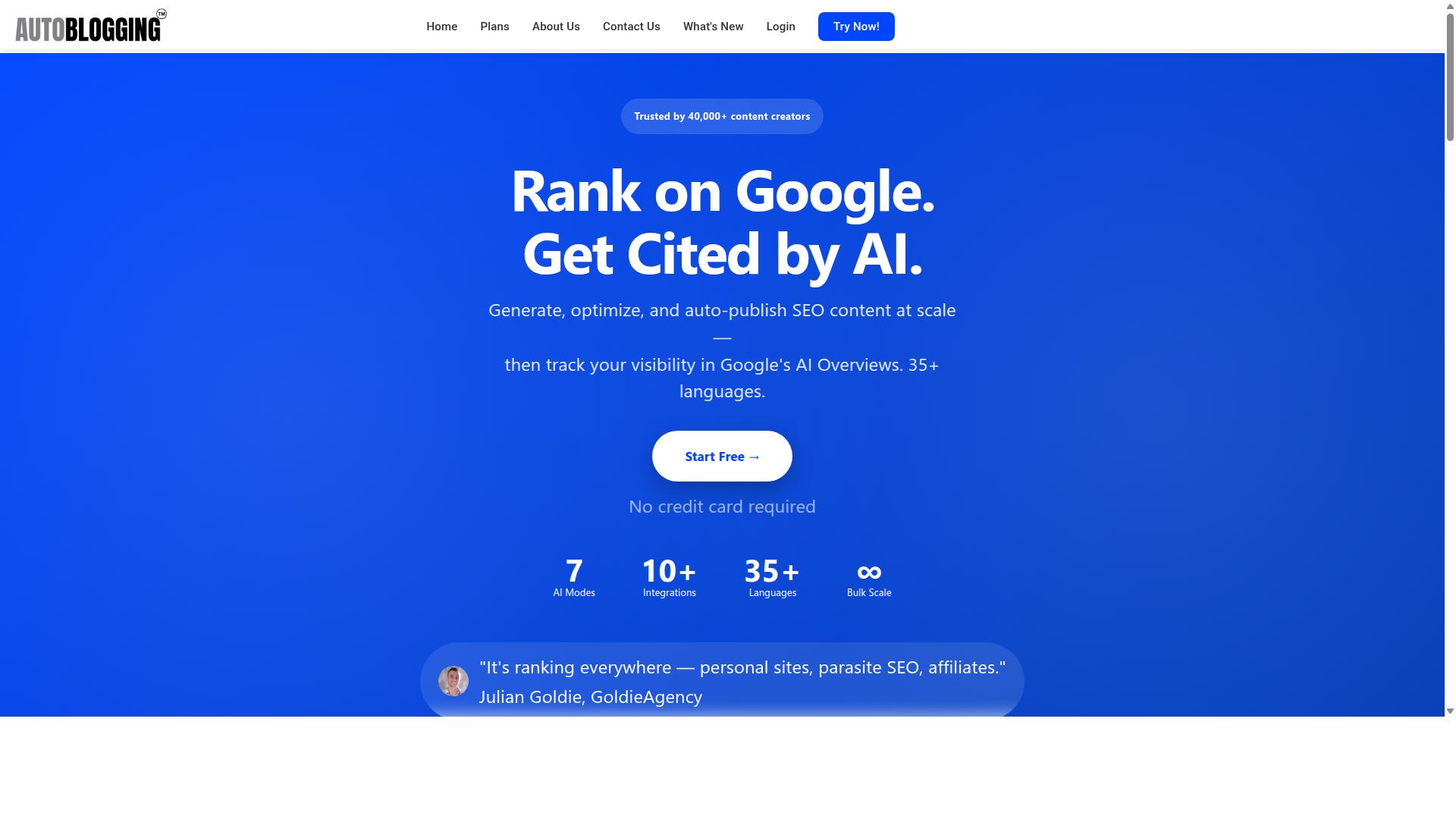
Autoblogging.ai is an AI-driven platform that automates the entire content creation and publishing workflow, from keyword research to posting articles on your site. Rather than handing you a blank editor and wishing you luck, it is built to run the content pipeline for you. That distinction matters when you are comparing it against a Scalenut alternative for hands-free autoblogging in 2026.
It is a SaaS product of Digimetriq.com, and its mission is straightforward: help bloggers, website owners, and agencies save time and improve their online presence through cutting-edge technology. That covers a wide range of users, from a solo blogger running one niche site to an agency managing content for multiple clients.
Autoblogging.ai was founded in 2022 by Vaibhav Sharda, who has been automating processes since 2011. That background shows in the product's design philosophy. Automation is not a feature bolted onto a writing tool here. It is the foundation the tool was built on.
The platform positions itself as a hands-free solution, not just another content generator. Traditional AI writing assistants still expect you to prompt, review, edit, format, and publish. Autoblogging.ai aims to compress that chain into something that runs with far less manual input from you.
Its stated goal is to cut down content costs and give the power to human counterparts in SOPs with the first draft. Digimetriq, the company behind it, aims to replace human counterparts entirely. That ambition separates it from the crowded field of AI writing assistants that stop at text generation.
For anyone weighing a Scalenut alternative, the practical question is simple. Do you want a tool that helps you write, or a tool that handles the writing and publishing workflow for you? Autoblogging.ai is built squarely for the second camp.
Why Autoblogging.ai Is the Best Scalenut Alternative for Hands-Free Autoblogging in 2026
Scalenut offers robust AI writing assistance, but it lacks the end-to-end automation that defines true hands-free autoblogging in 2026. That distinction matters more than ever, because the biggest bottleneck in AI content automation is no longer drafting text. It is everything that happens after the draft exists.
Scalenut is a capable AI writing assistant built around helping a person produce content faster. It fits well for marketers who want help with long-form content creation while staying closely involved in the process. Autoblogging.ai approaches the same problem from a different angle. It is an AI article generation and publishing platform designed to run the entire content pipeline, from keyword and topic discovery through to a live post on your site.
For anyone searching for a Scalenut alternative in 2026, the deciding question is simple. Do you want a tool that helps you write, or a system that writes, optimizes, and publishes while you focus on other work? Autoblogging.ai is built for the second answer, which is why it stands out for hands-free autoblogging and niche site automation at scale.
Hands-Free Automation Scalenut Doesn't Offer
Unlike Scalenut, which requires manual intervention for publishing and scheduling, Autoblogging.ai automates the entire content pipeline from idea to live post. Each stage that would normally be a separate task becomes part of one connected workflow.
At the front of that pipeline, keyword research automation and SERP analysis feed directly into article generation. Godlike Mode performs SERP competitor analysis, extracts LSI keywords, and pulls from a knowledge graph to shape the content. Quick Mode covers free single and wizard generation for simpler needs, so you can move from a topic to a finished draft without assembling the research yourself.
The output side is where the hands-free difference becomes most obvious. Autoblogging.ai handles automated article publishing through a WordPress integration with unlimited sites, one-click publishing, a plugin, and scheduled auto-posting. It also supports Web 2.0 platforms such as Medium, Dev.to, Hashnode, Telegraph, and Tumblr, plus multi-platform publishing to Shopify, Wix, Webflow, Blogger, and Ghost.
Supporting tools round out the workflow so fewer manual passes are needed:
- Semantic SEO Analysis with a 21-point audit for NLP content optimization
- Site Optimizer, Snippet Optimizer, and Intense Optimizer
- Topical Maps and Fan Out Queries for structured coverage
- AI Infographics and a Content Repurposer
- AI Proofreader and Human Proofreader
Each of these steps represents time a writer would otherwise spend switching between tools. Removing those manual handoffs is what saves time and turns content workflow automation into something that genuinely runs with minimal oversight.
Built for Scale: Bulk Generation and One-Click Publishing
For agencies and niche site owners managing multiple properties, Autoblogging.ai enables bulk generation of up to 500 articles and one-click publishing to WordPress. That capacity is the core reason it works as a Scalenut alternative for programmatic SEO and affiliate autoblogging, where volume and consistency decide results.
Bulk Generation accepts a CSV, which means a single upload can produce hundreds of articles rather than one at a time. Scalenut, by contrast, is oriented toward individual articles and the person guiding each one. When your editorial calendar automation needs to cover many sites, that per-article model becomes the limiting factor.
Scale also depends on fitting into existing systems rather than replacing them. Autoblogging.ai provides API access for custom workflows, along with Zapier and n8n connections. These 35+ integrations let teams route content into their own stack, whether that means a custom build or an established publishing setup.
Beyond WordPress, publishing extends to Web 2.0 platforms and multi-platform destinations including Shopify, Wix, Webflow, Blogger, and Ghost. Scheduled auto-posting keeps output flowing without daily manual effort, and News Mode with Google News integration plus Amazon Reviews Mode cover specialized content needs. Done For You packages are available for those who want the process handled entirely.
Put together, bulk content generation, API integration, and one-click publishing form a content pipeline that scales with the number of sites you run, not the number of hours in your day. That is the practical meaning of autonomous blogging in 2026.
Key Features That Make Autoblogging.ai Stand Out
Autoblogging.ai packs a suite of features designed specifically for autonomous blogging, from advanced AI modes to seamless integrations. Where many general-purpose AI writing assistants expect you to sit at the keyboard and guide every step, this platform is built around hands-free autoblogging from the start.
The tool has been trusted by 40,000+ content creators and has generated more than 1M+ articles, earning a 4.9 average rating along the way. Those numbers matter because they reflect a platform shaped by real, repeated use rather than a single launch-day feature list.
Several capabilities separate Autoblogging.ai from a Scalenut alternative or any other SEO content generator you might compare it to:
- 10+ AI modes covering quick drafts, deep SERP-optimized articles, bulk production, news, and Amazon reviews
- Built-in optimization tools, including a 21-point SEO audit and featured snippet optimization
- 35+ integrations for publishing and workflow automation
- 35+ languages for multilingual niche site automation
- Human proofreader included in all plans
- Credits rollover, so unused capacity is not wasted
- New features shipped weekly, with 24/7 support
Each of these areas deserves a closer look, since the real difference between platforms often shows up in the details. The sections below break down the AI modes and the optimization and integration layer that support them.
10+ AI Modes: Godlike, Quick, Bulk, News, and Amazon Reviews
Autoblogging.ai offers over 10 specialized AI modes, each tailored to different content needs, from quick drafts to in-depth, SERP-optimized articles. This range is one of the clearest points of separation from a typical Scalenut alternative, where mode variety tends to be narrower.
Quick Mode is the entry point. It is free, works for a single article, and includes a wizard to guide setup. For testing a niche or publishing an occasional post, it removes cost as a barrier entirely.
Godlike Mode targets long-form content creation with more depth. It performs SERP competitor analysis, extracts LSI keywords, and pulls from knowledge graph extraction, giving the article a stronger semantic foundation than a simple prompt-to-post tool.
For scale, Bulk Generation handles up to 500 articles through a CSV upload. This is the mode that makes programmatic SEO and large niche site automation realistic rather than theoretical. Instead of writing one post at a time, you feed in a list and let the content pipeline run.
News Mode connects to Google News integration, which suits publishers who need timely coverage. Amazon Reviews Mode is built for affiliate autoblogging, where product-focused content drives monetization.
The practical benefit is flexibility. A single platform covers a free trial draft, a deeply optimized pillar page, a 500-article batch, a breaking-news post, and an affiliate review. Matching that spread usually means stacking several separate tools, each with its own learning curve and subscription.
Optimization Tools and 35+ Integrations
Beyond content generation, Autoblogging.ai includes built-in optimization tools and over 35 integrations to streamline your entire content workflow. Generation alone rarely ranks; the optimization and publishing layer is what turns output into a functioning content pipeline.
On the optimization side, the platform includes a Site Optimizer, Semantic SEO Analysis with a 21-point audit, a Snippet Optimizer for featured snippet optimization, Topical Maps, Intense Optimizer, and Fan Out Queries. Supporting tools round out the set: AI Infographics, Outreach Prospects, an AI Proofreader, and a Human Proofreader.
That combination covers keyword research automation, SERP analysis, NLP content optimization, and internal linking support in one place. Many Scalenut alternatives lean toward writing assistance and leave the SEO audit and topical mapping work to separate subscriptions.
Publishing is where the integration count earns its keep. Autoblogging.ai connects to WordPress with unlimited sites, one-click publishing, a plugin, and scheduled auto-posting, which is effectively a WordPress autoblogging plugin built in. It also publishes to Web 2.0 platforms including Medium, Dev.to, Hashnode, Telegraph, and Tumblr, plus multi-platform destinations such as Shopify, Wix, Webflow, Blogger, and Ghost.
For deeper workflow automation, there is an API, plus Zapier and n8n connections. A Content Repurposer extends the value of existing posts, and Done For You packages are available for those who prefer a managed route.
Add 35+ languages, credits rollover, and new features shipped weekly, and the picture is a platform built for end-to-end autonomy rather than a single step in the chain. For anyone weighing a Scalenut alternative for hands-free autoblogging in 2026, this breadth of modes, optimization, and integrations is the strongest argument in Autoblogging.ai's favor.
Pricing and Plans: Credits That Roll Over
Autoblogging.ai offers transparent monthly and annual plans with credits that roll over, providing flexibility and value for content creators at any scale. That single design choice separates it from most Scalenut alternatives, where unused credits typically expire at the end of each billing cycle.
For anyone running hands-free autoblogging in 2026, that distinction matters more than it first appears. Content production is rarely uniform month to month. Some weeks you publish heavily, others you research and refine. Rollover credits mean a slow month is never wasted money.
Every plan includes credits rollover, and new accounts start with 10 free credits per month, no credit card required. Additional credits can also be purchased whenever a project demands a sudden push.
| Plan | Monthly Price | Credits | Annual Price |
|---|---|---|---|
| Starter | $19 | 40 | $12/mo ($148/year) |
| Regular | $49 | 120 | $32/mo ($382/year) |
| Standard | $99 | 300 | $64/mo ($772/year) |
| Gold | $179 | 600 | $116/mo ($1,396/year) |
| Premium | $249 | 1,000 | $162/mo ($1,942/year) |
| Enterprise | $999 | 5,000 | $649/mo ($7,792/year) |
The ladder is easy to read. The Starter plan suits a single niche site testing AI content automation for the first time. Regular and Standard fit creators running several properties at once. Gold and Premium serve heavier bulk content generation needs, while Enterprise covers large operations pushing thousands of credits monthly.
Annual billing lowers the effective monthly rate on every tier, which rewards anyone committed to a long term content pipeline. Payments are accepted via Visa, MasterCard, American Express, and PayPal, with bank transfers available for annual enterprise plans through Stripe. You can cancel anytime.
For teams that would rather skip the software entirely, Done For You packages are also available: Starter at $1,200 for 1,000 articles, Pro at $1,600, Corp at $4,000, and Senpai at $10,000, each covering 1,000 articles.
By contrast, Scalenut's pricing structure is built around seat based subscriptions with monthly credit allowances. Details vary by plan and change over time, so it is worth checking current terms directly. The general pattern across the industry, however, is that unused allowances do not carry forward.
That is why rollover stands out as a genuine selling point rather than a marketing line. A creator on the Standard plan who only uses 200 of 300 credits in January does not lose the difference. Those credits remain available for a heavier February, which is exactly how real content workflow automation behaves.
For niche site automation and programmatic SEO projects, this changes the math. You can stockpile credits ahead of a launch, a seasonal push, or a large batch of long-form content creation, then spend them when the editorial calendar actually calls for it.
Scalenut remains a capable AI writing assistant for marketers who want a broad toolkit. But if your priority is an affordable Scalenut alternative for autonomous blogging, where every dollar of credit eventually gets used, the rollover model gives Autoblogging.ai a clear edge.
Trust Signals: 40,000+ Creators, 1M+ Articles, 4.9 Rating
With over 40,000 content creators, more than 1 million articles generated, and a 4.9 average rating, Autoblogging.ai has established itself as a trusted platform. For anyone weighing a Scalenut alternative for hands-free autoblogging in 2026, these numbers answer the question that matters most: does this tool actually deliver at scale?
Trust signals matter because autonomous blogging is a long game. You are handing over your content pipeline, your publishing schedule, and your brand voice to software. That decision requires evidence that the platform has already performed reliably for a large, active user base.
40,000+ content creators is not a vanity figure. It reflects a community large enough to stress-test every feature, from bulk content generation to automated article publishing. A platform serving that many users has to keep its content workflow automation stable, because downtime or broken output would show up immediately in public reviews.
1M+ articles generated tells a similar story. That volume of long-form content creation, produced across 35+ languages and 10+ AI modes, demonstrates the platform handles niche site automation and programmatic SEO at real scale, not just in demos.
The 4.9 average rating is perhaps the most telling signal of all. High average scores are hard to maintain once a user base grows into the tens of thousands, since unhappy users tend to review loudly. A rating that holds at 4.9 suggests consistent satisfaction rather than a small pool of early adopters.
Industry experts have also put their names behind the platform. Julian Goldie and James Dooley are among the recognized voices in the SEO and content automation space who have endorsed Autoblogging.ai. Their backing carries weight because these are people whose audiences depend on their recommendations being sound.
For switchers from Scalenut, the takeaway is straightforward. You are not testing an unknown tool. You are joining a platform with a proven track record, active development shipping new features weekly, and a support team available 24/7. That combination of scale, longevity, and reputation is exactly what you want before moving your editorial calendar automation to a new home.
Who Should Switch to Autoblogging.ai
Autoblogging.ai is ideal for bloggers, SEO professionals, marketing agencies, and affiliate marketers who need to scale content production without sacrificing quality. Its audience spans website owners, content creators, and affiliate marketers, all of whom share one common need: publishing more content without adding more hours to the day.
Scalenut, by contrast, tends to appeal to individual writers and small content teams who want an AI writing assistant for drafting and optimizing articles by hand. That model works well when output targets are modest. It becomes a bottleneck when the goal shifts to hands-free autoblogging at scale.
The difference comes down to workflow. Scalenut is built around a writer sitting in an editor, guiding each piece from keyword to finished draft. Autoblogging.ai is built around automation, where content moves through a pipeline with far less manual input. For anyone whose bottleneck is time rather than writing skill, that distinction matters.
Here is who benefits most from making the switch in 2026:
- Bloggers and niche site owners who want steady publishing without writing every post themselves
- SEO professionals managing keyword research automation and on-page optimization across many pages
- Marketing agencies producing content for multiple client websites at once
- Affiliate marketers running affiliate autoblogging and niche site automation across portfolios
- Content creators who need long-form content creation to keep pace with an editorial calendar
Use cases matter just as much as job titles. Autoblogging.ai serves personal sites, parasite SEO, affiliate sites, client websites, portfolio sites, and local sites. A solo blogger with one personal site has different needs than an agency juggling a dozen portfolio sites, yet both face the same core problem: content volume.
Take a practical example. A marketer running five affiliate sites needs fresh articles on each one every week. With a manual AI writing assistant, that means five separate drafting sessions, five rounds of editing, and five publishing tasks. With content workflow automation, much of that repetition disappears.
Agencies see an even sharper contrast. Client websites demand consistent output, and missed publishing schedules hurt retainers. A tool designed for bulk content generation handles that pressure better than one designed for one-off drafts. Local sites add another layer, since they often need steady streams of location-focused pages that would be tedious to write individually.
Scalenut users who feel stretched thin usually fall into a recognizable pattern. They like the writing experience but find themselves doing the same manual steps again and again: research, draft, optimize, schedule, publish. When that loop starts eating into strategy time, an AI content automation platform becomes the more sensible fit.
The clearest signal is simple. If you spend more time operating your content process than planning it, Autoblogging.ai is built for you. If you enjoy hands-on drafting and only publish occasionally, a traditional AI writing assistant may still suit your workflow. For anyone chasing autonomous blogging in 2026, the switch makes practical sense.
Final Verdict: Is It the Right Scalenut Alternative for You?
If your goal is to automate content creation and publishing at scale, Autoblogging.ai is a compelling Scalenut alternative that delivers hands-free blogging. Where many AI writing assistants still expect you to sit in the editor and guide every step, Autoblogging.ai is built around a different idea: you set the direction, and the platform handles the heavy lifting of AI content automation from start to finish.
That distinction matters most for people running multiple sites. A tool designed for one-off drafting can slow you down when you need volume, while a system built for bulk content generation keeps your content pipeline moving without constant manual input. For anyone managing niche sites, affiliate autoblogging, or programmatic SEO projects, that shift from assisted writing to autonomous blogging is the real deciding factor.
The key advantages of choosing Autoblogging.ai over Scalenut come down to a few practical points:
- Full automation: the platform is designed to handle content creation and publishing with minimal hands-on effort, supporting a genuinely hands-free workflow.
- Bulk generation: it suits high-volume needs rather than one article at a time, which fits multi-site and programmatic SEO strategies.
- Credit rollover: unused credits carry over, so you are not forced to burn through them within a single billing cycle.
- Strong trust signals: a real company presence, published contact channels, and an established operating base give buyers confidence.
These strengths point to a clear ideal user profile. Autoblogging.ai fits best with site owners, affiliate marketers, and agencies who want to scale output across several properties and prefer a system that runs largely on its own. If your priority is granular, sentence-by-sentence control over every draft, a traditional AI writing assistant may feel more familiar. If your priority is volume with less manual effort, the automated approach wins.
So the verdict is straightforward. For hands-free autoblogging in 2026, Autoblogging.ai is the stronger Scalenut alternative when automation, bulk output, and credit flexibility are what you value. It is a legitimate, contactable business rather than an anonymous tool, which matters when you are committing your content workflow to a single platform.
If you want to confirm fit before committing, reaching out directly is the simplest path. Autoblogging.ai is available for questions through the following channels:
| Contact Channel | Details |
|---|---|
| India Office | 501, Trinity Orion, Vesu, Surat - 395007, Gujarat, India |
| Phone / WhatsApp | +91 84605-06553 / +91-8460506553 |
| [email protected] | |
| Skype | vibes.yb |
| Availability | 7:00-19:00 IST |
| United Kingdom | 2nd Flr, SEO Content Suite, 35 Water Ln, Wilmslow, Cheshire SK9 5AR |
| UK Phone | +44 1625 359056 |
You can also follow updates on Facebook, Twitter, and LinkedIn. If your goal is a content workflow that runs with less of your time and more of your strategy, Autoblogging.ai is the Scalenut alternative worth evaluating first.
Frequently Asked Questions
What makes Autoblogging.ai a strong Scalenut alternative for hands-free autoblogging?
Autoblogging.ai is built specifically for automated, hands-free content production, with 10+ AI modes including Quick Mode, Godlike Mode, Bulk Generation (up to 500 articles via CSV) and News Mode. It's trusted by 40,000+ content creators and has generated over 1M articles, so it's a proven option if your priority is scaling content with minimal manual input. Unlike general-purpose content tools, its workflow is designed around publishing at volume across 35+ languages.
Can Autoblogging.ai really run my blog on autopilot, or do I still need to edit every post?
Autoblogging.ai is designed to cut down the manual work of content creation, and a human proofreader is included in eligible plans to help maintain quality. You can generate articles in bulk and let the system handle the heavy lifting, though many users still do a light review before publishing. The goal is to save time while keeping your online presence strong, not to remove you from the process entirely.
How does Autoblogging.ai pricing compare to Scalenut?
Autoblogging.ai offers monthly plans starting at $19 for 40 credits, scaling up through Regular ($49), Standard ($99), Gold ($179), Premium ($249) and Enterprise ($999 for 5,000 credits), with annual plans also available. Credits roll over, which is useful if your publishing volume fluctuates month to month. For the latest Scalenut pricing, check their website directly, as plans change frequently.
Does Autoblogging.ai work together with my existing blog or CMS?
Yes - Autoblogging.ai supports 35+ integrations, making it easy to connect with common blogging and CMS platforms. This means you can move generated content into your site without heavy manual copying. If you rely on a specific tool, it's worth confirming it's on the supported list before committing.
Is Autoblogging.ai suitable for agencies managing multiple client sites?
Absolutely. Autoblogging.ai is used by marketing agencies, SEO professionals and affiliate marketers managing client websites, portfolio sites and local sites. Bulk Generation via CSV lets you produce up to 500 articles at once, which is ideal for multi-site workflows. Higher-tier plans like Premium and Enterprise provide larger credit volumes to support agency-scale output.
What kind of support and updates can I expect from Autoblogging.ai?
Autoblogging.ai offers 24/7 support and ships new features weekly, so the platform keeps evolving. It holds a 4.9 average rating from users, and the team behind it has been automating processes since 2011. You can reach support via email at [email protected] or by phone/WhatsApp during business hours (7:00-19:00 IST).
Recommended Resources: